Your Guide to Immersive Home Cinema Sound
Make Movie Nights & Game Day More Exciting
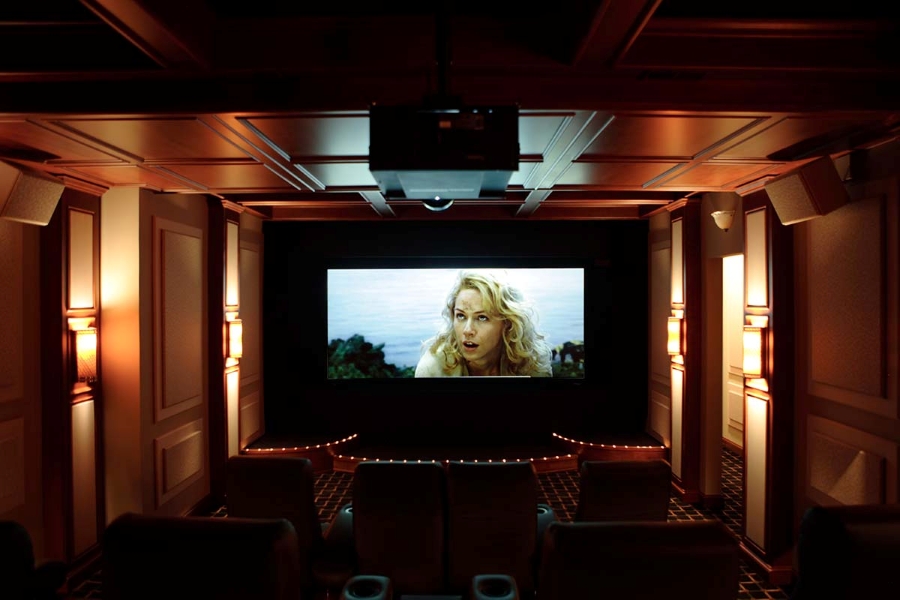
You’ve likely experienced it: you sit down to watch a blockbuster, but you’re constantly reaching for the remote to turn the volume up during dialogue and down during explosions. Or perhaps your surround sound feels flat, as if the audio is stuck to the walls rather than filling the room.
In a high-performance home theater, audio accounts for half of the cinematic experience. Whether you are refinishing a basement or repurposing an extra bedroom, the difference between a decent system and an Elite system lies in its design. Keep reading below to learn more.
MORE ON HOME THEATERS: The St. Louis Homeowner’s Guide to the Ultimate Media Space
Dolby Atmos vs. DTS:X
Traditional surround sound (5.1 or 7.1) sends audio to specific speakers—left, right, center, and behind you. Modern cinema has evolved into object-based audio, led by Dolby Atmos and DTS:X, which fully immerses the listener from every direction, including from above!
- Dolby Atmos: This is the gold standard for immersion. It adds the height dimension, treating each sound as an individual object that moves anywhere in a three-dimensional space. When a helicopter flies overhead in a movie, you don't just hear it in the back speakers; you hear it above you.
- DTS:X: While similar to Atmos, DTS:X is speaker agnostic, meaning it doesn't require a specific number of speakers to work as long as the speaker layout is symmetrical. It optimizes sound based on your room's layout, focusing on dialogue clarity and immersive depth.
Speaker Design & Seating Placement
For the best results, your entertainment space should be designed around the sweet spot, otherwise known as “the best seat in the house.”
- The Rule of Thirds: Avoid placing your seating directly against the back wall. This is where bass buildup occurs, making sounds muddy. Placing your primary seating about one-third of the way into the room keeps the viewer/listener in the heart of the soundstage.
- Ear-Level Alignment: Your primary speakers (Left, Center, Right) should ideally be at ear level when seated. For a clean, luxury aesthetic, architectural in-wall speakers can be hidden behind an acoustically transparent screen, perfectly aligning the sound with the action on screen.
Taming the Room: Reflection vs. Absorption
Even the most expensive speakers sound bad in a room with bad acoustics. St. Louis homes with hardwood floors or large windows often suffer from sound reflection, where sound waves bounce off hard surfaces, creating echoes and harsh tones.
- Absorption: We use specialized acoustic panels to effectively soak up excess energy, particularly behind the screen and at the first reflection points on the side walls.
- Diffusion: Instead of just deadening the room, we use diffusers to scatter sound waves. This makes a small room feel much larger and more airy, like a real commercial cinema.
Soundproofing vs. Sound Blocking: What’s the Difference?
This is a common point of confusion for homeowners.
- Acoustic Treatment (Soundproofing): This is about making the room sound better on the inside by managing echoes and vibrations.
- Sound Blocking: This is about keeping the sound inside the theater so you don't wake the kids upstairs. This requires specialized construction techniques, such as decoupling the walls or using high-density insulation, to stop sound from traveling through the home’s structure.
Hear the Difference for Yourself in Our Showroom
Technical specs and diagrams can only tell you so much. To truly understand how a calibrated surround sound system feels, you have to experience it.
Our experts are ready to show you how we can eliminate the tech-clutter and bring a world-class concert or cinema experience straight into your home! We invite you to book a visit to our private showroom to feel the floor-shaking bass of a properly tuned subwoofer and the pin-drop clarity of architectural audio.
